Home › Road, Street, and Municipal Paving
Precision Asphalt Indianapolis delivers road paving in Indianapolis, IN for municipal streets, subdivisions, and public access routes. Our crews handle new construction, widening, and resurfacing with the right equipment and traffic control. We coordinate with stakeholders and follow local specifications to produce smooth, safe driving surfaces. Support your community with durable asphalt roads installed by experienced professionals.
Precision Asphalt Indianapolis provides professional road paving throughout Indianapolis, IN, Indiana and the surrounding area. Our licensed, insured crew delivers safe, clean, on-time work with a free estimate before anything begins. Call (317) 793-2897 or request your free quote.
Road and Municipal Paving for Central Indiana Communities
Road paving in Indianapolis is not a one-size-fits-all job. City streets in older neighborhoods like Irvington, busy corridors feeding I-465, and local municipal lots all see different traffic loads and wear patterns from freeze-thaw cycles. Precision Asphalt Indianapolis focuses on building pavement sections that match actual use, not a generic standard cross section.
When we look at a road or municipal project, we start with how the pavement will be used: school bus traffic, trash trucks, snowplows, semi deliveries, or mostly passenger cars. For arterial streets and industrial park roads around Indy, we specify thicker asphalt lifts and a more robust aggregate base than for a quiet residential lane. For municipal clients, we also account for utilities, drainage patterns, and existing curb and gutter so the new pavement ties in cleanly and does not create ponding.
Our team has completed work for HOAs, small towns around Marion County, and private streets serving multi-building complexes. That experience matters because each has different standards, budget cycles, and approval steps. We speak the language of public works directors, property managers, and city engineers, which keeps your project moving instead of stalled in review.
How We Evaluate Existing Roads Before Paving
Good road paving starts with a hard look at what is already there. In Indianapolis, many local streets were built decades ago on marginal subgrade, then patched repeatedly instead of reconstructed. Before we talk about tons of asphalt, Precision Asphalt Indianapolis inspects the structure below the surface.
We start with a visual survey. Alligator cracking, raveling (where the aggregate loosens), rutting in wheel paths, and edge failures each point to different underlying issues. Linear cracks along trenches often indicate utility cuts that were not properly compacted. Depressions near manholes and inlets tell us the frame supports or backfill may be failing.
Next, we perform test cuts or cores where needed. This lets us measure existing asphalt thickness, base depth, and subgrade conditions. On some Indianapolis streets, we find 2 inches of asphalt over almost no stone base, which explains chronic failures. In other cases, the asphalt is thin but the base is solid, so a mill and overlay is a smart, cost-effective choice.
We also check drainage. In this climate, water that cannot leave the pavement structure will turn to ice in winter and break the road apart. We use levels or laser equipment to confirm that after paving, water will move to inlets, ditches, or gutters instead of sitting in the travel lanes. If we find poor drainage, we include spot grading, underdrains, or inlet adjustments in our proposal so issues are solved, not covered up.
Step-by-Step: Our Road Paving Process in Indianapolis
Once the design and scope are set, Precision Asphalt Indianapolis follows a defined process that keeps traffic moving and keeps results consistent.
1) Traffic control and coordination. For municipal streets, we coordinate with public works, schools, bus routes, and emergency services. On residential roads we notify HOA boards or property managers so residents know dates and access plans. We set up signage and barricades based on MUTCD standards so drivers are not surprised.
2) Milling or full-depth reclamation. For typical city streets and subdivision roads, we mill (grind) 1.5 to 3 inches of old asphalt so curbs, driveways, and manholes stay at the right height. Where the pavement is structurally failed, we may recommend full-depth reclamation, which pulverizes existing asphalt and base together and reuses it as a stabilized foundation.
3) Base and subgrade repair. After milling, weak areas usually show clearly. We dig out soft spots, add compacted aggregate (commonly No. 53 stone in Indiana), and proof-roll with heavy equipment to confirm stability. Skipping this step is why some roads in the region develop new potholes within a year. We do not pave over mush.
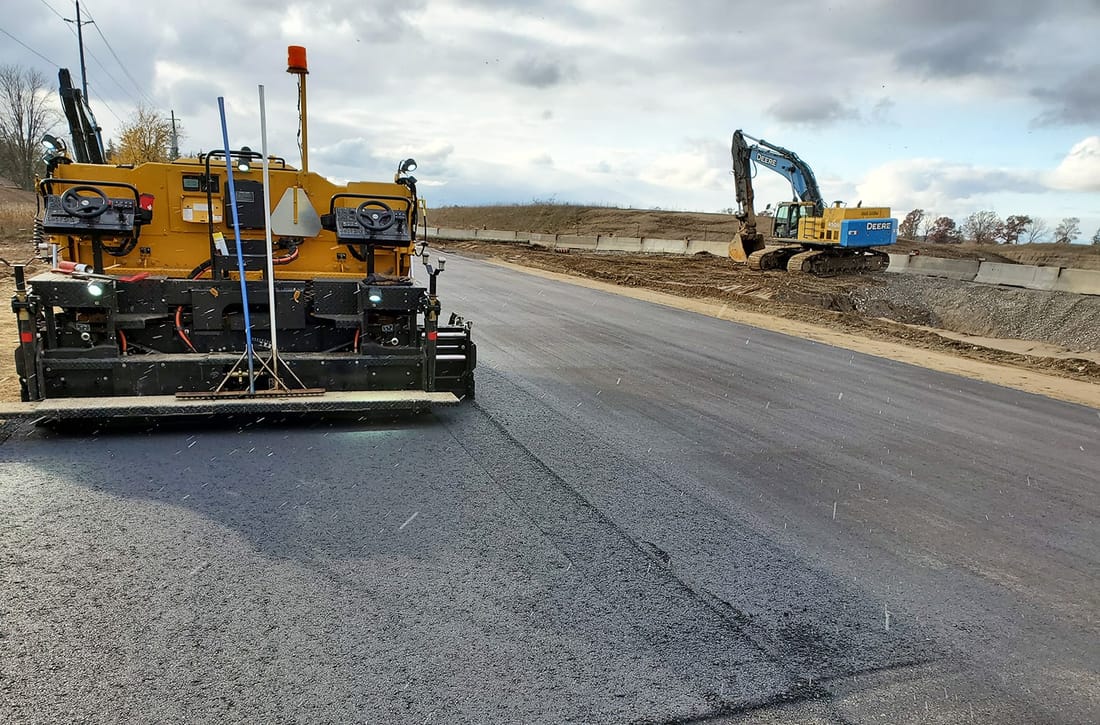
4) Asphalt placement in lifts. For most local roads in Indianapolis, we install a binder course (structural layer) and a surface course. Typical thicknesses range from 2.5 to 4 inches total, but heavily loaded routes, bus lanes, and industrial park streets may need 5 or more. We use state-approved asphalt mixes suitable for Indiana DOT and local specs, with PG-graded binders that handle our temperature swings.
5) Compaction and quality checks. Rolling at the right temperature is critical. Our crews coordinate truck timing so mix is compacted while it is still workable, even on cooler fall mornings. We monitor joint quality, density, and smoothness. Poor compaction is one of the biggest causes of premature asphalt failure, so we treat this as non-negotiable.
6) Adjustments, striping, and cleanup. We raise or lower manholes and inlets to match the new surface, then apply striping and markings according to city or county standards. For municipal jobs, this can include crosswalks, school zone markings, and bike lanes where required. We remove millings and debris so when we leave, the road is clean, open, and ready for service.
Material Choices, Mix Designs, and How They Affect Cost
Road paving cost in Indianapolis is driven by more than just the price per ton of asphalt. When Precision Asphalt Indianapolis builds a proposal, we look at materials, structure, access, and schedule so you can see where your dollars are going.
Asphalt thickness and section design. A quiet residential cut-through with light traffic can often perform well with 3 inches of asphalt over a well-compacted base. A collector street serving warehouses near the interstates might require 6 or more inches of asphalt in multiple lifts, sometimes over a stabilized subgrade. More thickness and more structural layers mean more cost, but they also prevent rutting and base failure under truck traffic.
Aggregate base and subgrade improvement. Many older Indy streets have thin or inconsistent stone bases. Adding or rebuilding a proper base layer with compacted aggregate significantly improves lifespan but does add to upfront cost. In some clay-heavy areas around Indianapolis, we may recommend chemical stabilization of the subgrade (such as lime or cement treatment) to reduce pumping and seasonal movement.
Asphalt mix type. Surface courses can use standard dense-graded mixes, higher-polymer mixes for added rut resistance, or specialty quiet or high-friction surfaces in select locations. For municipal budgets, we usually balance performance and cost with standard dense-graded mixes that meet local specifications, reserving premium options for spots that see constant braking or turning, such as approaches to traffic signals.
Access, staging, and phasing. Roads that require extensive traffic control, night work to avoid rush hour, or complicated tie-ins to state routes will cost more because the crew spends more time on setup and safety. We design phasing plans that keep critical access open, for example one lane open for emergency vehicles or alternating one-way traffic with flaggers. Longer, simpler stretches are typically more economical per square yard than short, segmented projects with many driveways and intersections.
Common Road Problems in Indianapolis and How We Address Them
Local road and street pavements in Indianapolis share a few recurring problems: potholes, edge failures, reflective cracking from old joints, and water damage from poor drainage.
Potholes and patchwork surfaces usually indicate chronic water infiltration or thin structure. Rather than repeating cold patch every winter, Precision Asphalt Indianapolis identifies root causes. Where subgrade or utilities are failing, we perform full-depth repairs, replacing base and asphalt around the pothole area and tying back into sound pavement with clean, saw-cut edges.
Edge failures are common along residential streets without full curb and gutter, especially where vehicles pull off onto soft shoulders. To fix this, we extend or rebuild the base to support the wheel paths, often adding a paved shoulder or thickening the edge section. This prevents the crumbling that starts when unsupported asphalt is repeatedly driven over.
Reflective cracking from old concrete or asphalt joints is another Indianapolis reality, especially on older roads that were simply overlaid. For those, we may recommend milling deeper to break the bond with old joints, adding an intermediate asphalt layer, or using crack-relief methods as appropriate to the budget and expected life. We also perform thorough crack sealing on existing pavements that will stay in service.
Drainage-related failures are a big issue in our freeze-thaw climate. Standing water along the gutter line, at intersections, or around inlets accelerates damage. When we pave, we correct grades where possible, reset or raise inlets, and may add underdrains or outlet cuts so trapped water has somewhere to go. The goal is to keep water away from the base and subgrade, which dramatically extends pavement life and reduces maintenance calls.
What Indianapolis Clients Should Know Before Hiring a Road Paving Contractor
Before selecting a contractor for road, street, or municipal paving, it helps to know what to ask. Precision Asphalt Indianapolis encourages Indy-area clients to look beyond the lowest line item and focus on scope clarity and experience.
Ask for a clear section design. Your proposal should state approximate asphalt thicknesses per lift, whether base repair is included, and how many square yards or lane miles are covered. Vague terms like "resurface as needed" usually lead to change orders and disputes.
Clarify traffic control and access. For HOAs and private streets, you need a written plan for how residents reach homes, how long driveways are blocked, and which days parking is restricted. For municipal work, ask how the contractor will coordinate with police, fire, and trash pickup so services are not disrupted.
Confirm materials and specs. Make sure the mixes and aggregates meet City of Indianapolis, county, or INDOT standards where applicable. If a lower-cost alternative is proposed, ask what tradeoffs you are making in terms of lifespan and maintenance.
Review schedule and season. In central Indiana, the best paving window is typically late spring through early fall. Work can be done outside that range, but mix temperature and compaction become more critical. If your project is scheduled in cooler months, ask how the contractor will handle compaction and weather delays.
Finally, expect communication. For public and private roads that affect many people, confusion creates complaints. Our team assigns a point of contact who updates you on schedule changes, phasing, and any unexpected conditions that show up once milling begins. That way, you are not left explaining surprises to residents, council members, or property owners without current information.